

Cold Smoking vs Hot Smoking: Key Differences, Temperatures & Best Uses
Cold smoking and hot smoking use smoke for flavour, but they are fundamentally different processes. Compare temperatures, food safety, texture, timing, equipment and the best method for fish, meat, cheese and more.


Cold smoking and hot smoking both use wood smoke to build flavour, aroma and colour, but they are not interchangeable techniques. The biggest difference is simple: hot smoking cooks the food while it smokes; cold smoking generally does not. That difference changes the temperatures you use, how you prepare the food, what texture you get and, most importantly, how you manage food safety.
If you are choosing between cold smoking and hot smoking for salmon, trout, meat, cheese or a kamado setup, this guide explains the practical differences without oversimplifying them. Temperatures below are useful working ranges, not universal safety rules: the correct process depends on the food, its preparation and local food-safety guidance.
Cold smoking vs hot smoking at a glance
| Factor | Cold smoking | Hot smoking |
|---|---|---|
| Main purpose | Add smoke flavour with minimal heat | Cook and smoke at the same time |
| Typical chamber range | Often about 15–30°C / 59–86°F | Often about 80–150°C / 176–302°F depending on food and cooker |
| Does it cook the food? | Usually no | Yes |
| Typical duration | Several hours to much longer | Roughly 1–8+ hours depending on the cut |
| Texture | Firm, cured, silky or unchanged by heat | Cooked, tender, flaky or barked |
| Best known uses | Salmon, trout, cheese, salt, nuts, cured meats | Ribs, brisket, poultry, pork, fish, sausages |
| Safety approach | Curing, hygiene, cold chain and validated handling matter because smoke is not a cooking step | Food must reach a safe internal temperature appropriate to the product |
The key idea: smoke is a flavouring and preservation-related process; heat is what cooks. In hot smoking those two happen together. In cold smoking you deliberately separate smoke production from significant heat.
What is cold smoking?
Cold smoking exposes food to a controlled flow of smoke while keeping the smoking chamber cool enough that the food is not conventionally cooked. In practical home setups, users often aim to stay below roughly 30°C / 86°F, and many foods are smoked at even lower temperatures. The exact acceptable temperature depends on the product and the process.
That low-temperature environment is why a dedicated cold smoke generator can be useful: the combustion zone that creates smoke is separated from the food chamber, reducing unwanted heat transfer and giving you more control over smoke flow.
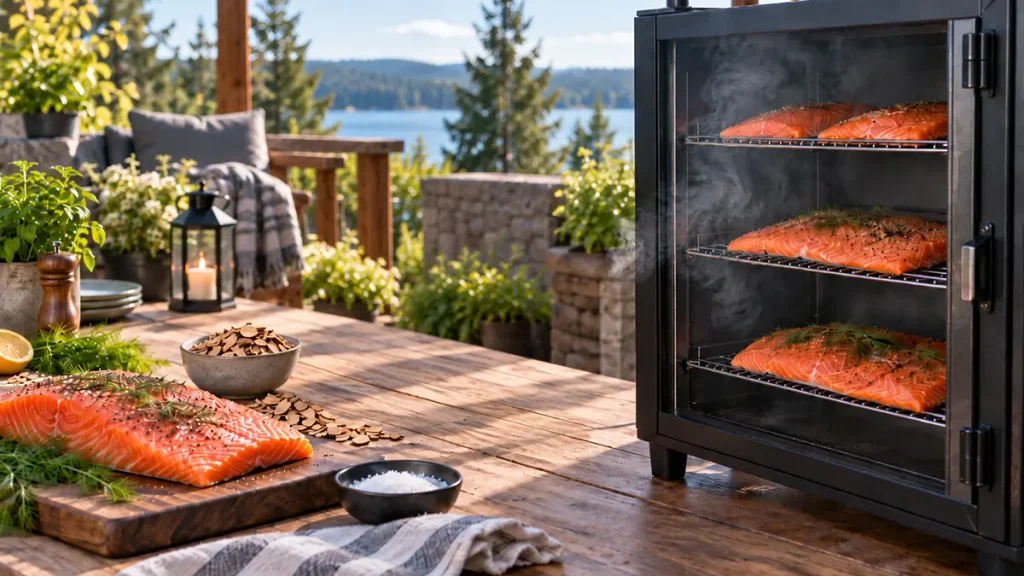
Cold smoking is especially well known for cured fish and meat, but it is also excellent for foods that you do not want to melt or cook, such as cheese, butter, salt, garlic and nuts. For fish, the preparation step matters at least as much as the smoke itself. See our detailed guide to cold smoking fish at home for curing, pellicle formation, wood choice and temperature control.
What is hot smoking?
Hot smoking combines smoke with enough heat to cook the food. The smoker therefore functions as both a smoke chamber and a low-and-slow cooker. Chamber temperature varies by product and equipment, but for meat and poultry a common smoking environment is around 107–149°C / 225–300°F. Fish is often hot-smoked at lower chamber temperatures than large cuts of meat.
With hot smoking, do not judge doneness by time, colour or the appearance of a smoke ring. Internal temperature is the safety measurement that matters. USDA guidance, for example, lists minimum internal temperatures of 63°C / 145°F for whole cuts of beef, pork, veal and lamb with a three-minute rest, 71°C / 160°F for ground meats, 74°C / 165°F for poultry and 63°C / 145°F for fish and shellfish. Always follow the rules that apply where you live and to the food you are preparing.
The most important difference: cooking vs flavouring
A frequent beginner mistake is to think that smoke itself makes raw food safe. It does not. Smoke contains compounds that affect flavour, aroma, surface colour and microbial growth, but cold smoke is not a substitute for a validated cure, correct storage or cooking.
Hot smoking is easier to understand from a cooking perspective because the food is heated through. Cold smoking requires more process discipline because the food can spend hours in an environment where it is being flavoured but not cooked.
Temperature: why chamber temperature and internal temperature are different
Two temperatures matter in smoking, and confusing them leads to poor results:
- Chamber temperature is the air temperature around the food. It tells you whether your process is truly cold smoking or hot smoking and how aggressively the food is heating.
- Internal temperature is measured inside the food. In hot smoking this is what tells you whether meat, poultry or fish has reached the required degree of cooking and safety.
In cold smoking, a low chamber temperature is a process condition, not proof that the food is safe to eat. In hot smoking, a stable chamber temperature helps the cook progress predictably, but you still verify the food itself with a reliable thermometer.
How flavour and texture differ
Cold smoking usually creates a more delicate, integrated smoke character because the food can remain in light smoke for a long time without developing cooked flavours. Cured salmon, for example, stays silky and sliceable rather than becoming flaky.
Hot smoking creates a different profile: rendering fat, browning reactions and protein denaturation happen alongside smoke absorption. A hot-smoked salmon fillet becomes opaque and flaky; a pork shoulder becomes tender and pullable; ribs develop bark. The smoke may be equally pronounced, but the texture and overall flavour are transformed by cooking.
Which foods are better cold smoked?
- Salmon and trout: classic choices when properly cured and handled.
- Cheese: cold smoke adds flavour without melting the cheese.
- Salt and spices: no cooking is required, so low-temperature smoke is ideal.
- Nuts and garlic: useful when you want smoke character without roasting them heavily.
- Properly cured meats: only when using an appropriate, validated curing process.
Which foods are better hot smoked?
- Brisket, ribs and pork shoulder: they benefit from long cooking plus smoke.
- Chicken and turkey: hot smoking cooks the poultry while adding smoke flavour.
- Fresh sausages: when the goal is to cook them through during the smoke session.
- Fish for immediate serving: hot-smoked salmon, trout and mackerel are cooked, flaky and ready to eat after proper handling.
Food safety: the part you should not simplify
Cold smoking deserves extra caution because there is no reliable kill step from heat. This is particularly important with ready-to-eat fish. The European Food Safety Authority notes that Listeria monocytogenes can occur in smoked fish and can grow even at refrigerator temperatures. People at higher risk of listeriosis, including pregnant people, older adults and people with weakened immune systems, should follow national food-safety guidance carefully.
For reference, see EFSA’s guidance on Listeria and the USDA guidance on smoking meat and poultry. These sources are useful for understanding why refrigeration, hygiene, curing and internal temperatures matter, but your local rules and the specific recipe or validated process should take priority.
Equipment: can the same smoker do both?
Sometimes yes, but the heat and smoke sources must be controllable independently. A ceramic grill, metal cabinet or kamado can work as the food chamber for both methods. For hot smoking, the grill’s fire supplies the cooking heat. For cold smoking, a separate smoke generator supplies smoke while you keep the chamber cool.
A separate generator also makes it easier to manage airflow and avoid the common problem of trying to make smoke inside the food chamber and accidentally raising the temperature. Tiskre-DO’s SG1 with passive cooler and SG2 with active cooler-filter are designed for this type of controlled cold-smoke setup.
Smoke quality matters more than smoke quantity
Whether you smoke hot or cold, dense white smoke is not the goal. Clean, steady combustion and good airflow usually produce a more pleasant result. Too little oxygen can create harsh, bitter smoke and excessive deposits of soot and tar-like condensate.
Use clean, food-safe smoking wood. Alder, beech, apple and other fruit woods are popular for fish and cheese; oak and stronger woods can suit robust meats but are easier to overdo. Avoid painted, treated, glued, mouldy or unidentified wood.
Cold smoking or hot smoking: which should you choose?
| If your goal is… | Choose |
|---|---|
| Silky cured salmon that stays uncooked in texture | Cold smoking |
| Flaky salmon that is cooked and ready to serve | Hot smoking |
| Adding smoke to cheese without melting it | Cold smoking |
| Cooking ribs, brisket, poultry or pork shoulder | Hot smoking |
| Smoking salt, spices or nuts without significant heat | Cold smoking |
| A simple one-session cook with smoke flavour | Hot smoking |
If you are a beginner, hot smoking is usually easier for raw meat and poultry because the process includes cooking. Cold smoking becomes highly rewarding when you are comfortable controlling temperature, smoke quality, curing, hygiene and refrigeration.
Common misconceptions
- “Cold smoking means the food is refrigerated while smoking.” Not necessarily. It means the smoke chamber is kept low enough to avoid conventional cooking. The food still needs an appropriate safe process.
- “More smoke means more flavour.” Excessive dirty smoke often creates bitterness rather than better flavour.
- “If meat looks smoked, it is cooked.” Colour is not a reliable safety indicator. Use a thermometer in hot smoking.
- “Cold smoking preserves food by itself.” Traditional preservation depends on a combination of factors such as salt, drying, temperature and storage, not smoke alone.
Frequently asked questions
Is cold smoking the same as low-and-slow barbecue?
No. Low-and-slow barbecue is still a hot-smoking method because the chamber is warm enough to cook the food over time. Cold smoking is designed to add smoke with minimal cooking heat.
What temperature is considered cold smoking?
There is no single universal number for every food and process. In home smoking, a common practical range is roughly 15–30°C / 59–86°F, with many products smoked toward the lower part of that range. Treat this as process guidance, not as a food-safety guarantee.
Can I cold smoke raw meat?
Not safely by simply placing raw meat in cold smoke. Cold-smoked meats normally rely on a suitable curing and preservation process, and some products are cooked later. Use a validated recipe or professional guidance for the specific product.
Can I hot smoke cheese?
You can expose cheese to warm smoke, but most cheeses soften or melt as temperature rises. Cold smoking is normally the better method when you want to keep the original shape and texture.
Do I need a separate cold smoke generator?
Not in every setup, but separating smoke generation from the food chamber makes temperature control easier, especially in a kamado or insulated smoker where even a small fire can raise chamber temperature quickly.
Bottom line
Choose cold smoking when you want smoke flavour without cooking the food; choose hot smoking when you want to cook and smoke in the same session. The techniques overlap in their use of wood and airflow, but they require different thinking about temperature and safety.
If your next project is salmon or trout, start with our step-by-step cold-smoked fish guide. If you already have a grill or smoking chamber and want more control over low-temperature smoke, compare the available cold smoke generators and smoking equipment.
[…] you are still deciding between methods, start with Cold Smoking vs Hot Smoking. If you already know you want cold smoke, the steps below are the operating […]
[…] are new to the subject, first make sure cold smoking is actually the process you need. Our guide Cold Smoking vs Hot Smoking explains the difference in temperature, cooking effect, flavour and food-safety […]