

Cold Smoking in a Kamado: External Generator Setup
Learn how to cold-smoke in a ceramic kamado using an external SG1/SG2 smoke generator: adapter compatibility, airflow, chamber temperature, troubleshooting and safety.

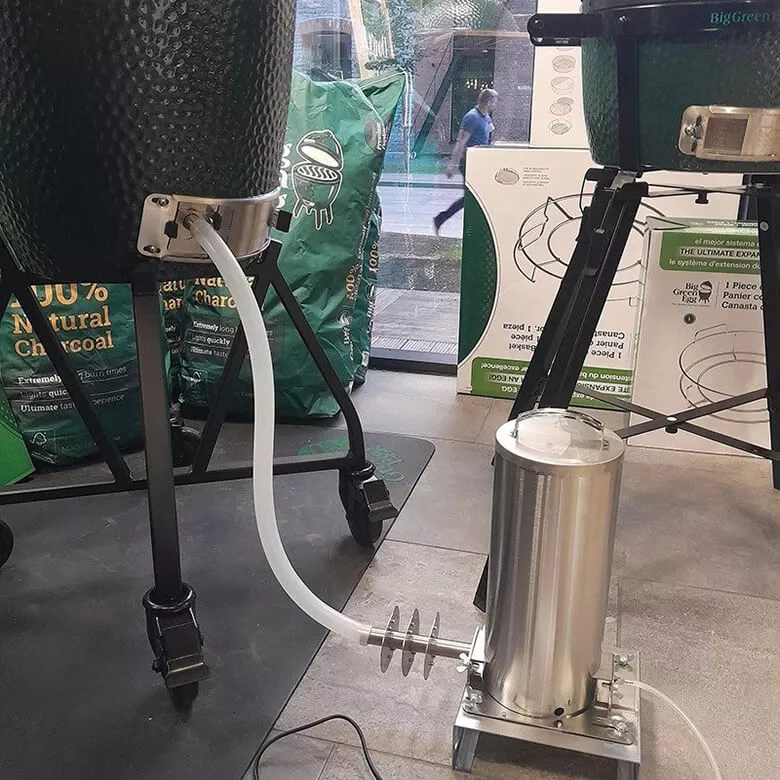
Can you cold-smoke in a ceramic kamado grill without lighting charcoal? Yes, if your particular grill permits a suitable smoke connection, an external cold smoke generator can supply smoke while the kamado acts as the smoking chamber. But the setup is different from conventional hot smoking: you must control the smoke path, measure the chamber temperature and keep food safety separate from equipment performance.
Quick answer: start with a completely cool kamado, no lit charcoal and an appropriate removable smoke-inlet adapter. Direct smoke into the chamber, leave a controllable exhaust path at the upper vent, check the temperature at food level, and run a short empty-chamber test before smoking food. The TISKRE-DO SG1 offers a passive three-plate cooler; SG2 adds an active five-layer cooler-filter with a condensate jar. Neither one guarantees a fixed food or chamber temperature.
What changes when a kamado becomes a cold-smoking chamber?
A kamado is a ceramic grill designed to retain heat. That is an advantage for cooking, but it can work against cold smoking if the ceramic body is already warm from a previous barbecue or heated by direct sunlight. The goal here is not to maintain a charcoal fire: smoke is generated outside the kamado, while the grill is used as a contained chamber with a controllable exit for smoke.
There are three parts to get right: smoke inlet (a suitable adapter and seal), smoke outlet (an upper vent that is not fully sealed), and temperature measurement (a probe close to food level, not merely the dome gauge). Cold smoke should move through the chamber and out; it should not be forced into a completely airtight container.
Before you buy: the kamado compatibility checklist
- Inlet: Does your model have an opening that can accept a suitable removable adapter without damaging the ceramic body or interfering with a vent? Check actual dimensions, not just the grill brand.
- Outlet: Can the upper vent stay partially open to let smoke escape? Do not create a sealed pressure vessel.
- Stability: Is there a secure, dry, heat-safe place for the generator and air pump alongside the grill? Keep the hose clear of sharp edges and hot parts.
- Temperature: Can you monitor the temperature where the food sits and respond if it rises? The dome thermometer may not represent the full chamber.
- Food space: Is there enough room to keep food away from the smoke inlet and allow circulation? Avoid crowding shelves or grates.
- Manufacturer guidance: Can you connect the equipment without drilling, modifying the grill or invalidating its safe operating instructions? Do not assume every kamado accepts the same adapter.
Do not drill or cut the ceramic body as a routine installation step. If the inlet cannot be fitted safely, consider a compatible smoking cabinet instead. The universal adapter included with SG1/SG2 is designed for common ceramic and metal grill setups, but it is not a verified fit for every kamado model.
Step-by-step: test an external smoke generator with a kamado
- Let the kamado cool fully. Remove any lit charcoal or heat source; verify that stored heat from a previous cook has dissipated. Operate outdoors, away from enclosed spaces and combustible surroundings.
- Plan the smoke route. Identify a compatible low-position smoke inlet and an upper exhaust. Leave a controlled path for the smoke to exit the chamber.
- Install the adapter without forcing it. Secure the tube and hose, avoid kinks, and protect flexible parts from hot metal and sharp ceramic edges. Never obstruct safety-critical vents.
- Prepare the generator. Both SG1 and SG2 use a 5.1 L, Ø130 mm chip container with dry 3–8 mm wood chips. Do not pack the chips down. Each model includes a grill adapter, a 0.6 m silicone hose and 1 L of alder chips.
- Ignite according to the SG1 or SG2 assembly instructions. Establish a stable smoulder outside the chamber. Never use chemical fire accelerants.
- Start with moderate airflow. Open the upper exhaust enough for fresh smoke to pass through. Adjust the pump gradually; maximum pump output is not the goal.
- Run an empty-chamber test. Confirm that smoke travels through the food zone and out of the vent, that there are no leaks or obstructions, and that the measured chamber temperature stays appropriate for the intended process under current weather conditions.
- Only then consider food. Use a suitable food-specific preparation method, check temperature throughout the session and stop if safe conditions cannot be maintained.
This is a kamado-specific planning guide, not a replacement for the full SG1/SG2 assembly, lighting and cleaning instructions or the kamado manufacturer’s directions.
Where should the smoke enter and leave?
For many kamado layouts, a lower suitable opening can act as a smoke inlet and the top vent as the exhaust. The exact connection method depends on the grill design. Do not claim a universal lower-vent fit: door shape, clearances, gasket design and adapter size vary significantly by model.
Watch what happens during the empty test. Smoke should travel steadily from inlet to outlet rather than escaping mostly around the lower door or pooling without a way out. A little visible exhaust is expected. Closing every vent completely is not a method for improving smoke contact; it can restrict flow and lead to leakage or unstable combustion.
Keeping the kamado cool: the ceramic heat problem
Thick ceramic retains heat. For cold smoking, begin with equipment that has not recently been used for grilling and avoid direct sun or other heat sources. Measure the chamber temperature at the height of the food. Do not use one universal temperature target for fish, cheese and meat: the safe process depends on the specific ingredient, preparation and applicable food-safety guidance.
If the chamber becomes too warm, stop the attempt instead of assuming the external cooler makes it safe. The cooler can reduce smoke heat on its way to the chamber, but it cannot overcome all ambient conditions or heat stored in a ceramic grill. Cold smoking also does not cook food.
SG1 or SG2 for a ceramic grill?
| Question | SG1 | SG2 |
|---|---|---|
| How is smoke cooled? | Passive three-plate cooler | Active five-layer labyrinth cooler-filter |
| Condensate collection | No dedicated glass collection jar | Glass jar for condensate |
| Air pump | YE-923 | One dual-chamber YE-922 unit |
| Chip size and capacity | Dry 3–8 mm; 5.1 L | Dry 3–8 mm; 5.1 L |
| Practical consideration | Simpler external smoke path and maintenance | Extra cooling/filter stage and condensate management |
Choose SG1 when a simple passive cooling arrangement is sufficient for your tested setup. Consider SG2 if an additional cooler-filter and condensate collection would help. **Neither model makes a hot kamado automatically suitable for cold smoking.** For a detailed product-by-product buying decision, read the SG1 vs SG2 comparison.
Common problems: diagnosis before adding food
| What you see | What it may mean | What to do |
|---|---|---|
| Smoke escapes mainly at the lower inlet | Poor adapter fit or restricted upper exhaust | Check the inlet seal and keep a controlled outlet; do not force an incompatible fitting. |
| Very little smoke reaches the food area | Blocked tube, kinked hose, inadequate or uneven smoulder | Inspect the route and generator airflow; use dry 3–8 mm chips. |
| Chamber temperature continues to rise | Warm ceramic, direct sun, hot weather or other residual heat | Stop; allow cooling or postpone until appropriate conditions are possible. |
| Water or sticky liquid accumulates | Condensation in a cooling smoke path | Inspect and clean the tube/cooler; check and empty SG2’s glass jar as needed. |
| Smoke output fluctuates | Dense fuel packing, moisture or unstable airflow | Inspect chip quality, leaks and pump setting; consult the full operating guide. |
For fuel-specific issues, see wood chips for cold smoking: types, size and airflow.
Food safety: especially important with cold-smoked fish
External smoke generation does not pasteurise or cook fish and meat. Cold smoking does not reliably kill Listeria or parasites; food safety depends on raw materials, suitable validated curing or other treatments, hygiene, time/temperature control and refrigerated storage. Follow food-specific guidance instead of assuming that a particular kamado vent setting is safe. The CDC explains the particular Listeria risk in cold-smoked fish.
For detailed ingredient preparation rather than equipment setup, read our guide to cold-smoking fish at home.
Questions kamado owners often ask
Can I cold-smoke in a kamado without charcoal?
Yes, with a safe compatible external smoke connection and a suitable monitored food process. The smoke generator produces smoke outside the ceramic chamber; no charcoal fire is required inside.
Can I connect SG1/SG2 through any kamado bottom vent?
No universal fit is guaranteed. Check the dimensions and mechanical design of your grill and adapter. Do not force or permanently modify ceramic parts.
Should the top vent be shut to keep the smoke inside?
No. The chamber needs controlled through-flow and an exhaust path. A fully sealed chamber may cause poor flow and smoke leaks.
Will SG2 keep the kamado at a fixed cold-smoking temperature?
No. SG2 adds active smoke cooling and condensate collection, but chamber temperature also depends on ceramic heat, weather, airflow and the smoking setup.
Can I use the same technique in a steel smoking cabinet?
The broad external-smoke principle is similar, but the cabinet has different thermal behaviour and inlet hardware. Always check the individual equipment.
Ready to plan a compatible setup? Compare the SG1 cold smoke generator with passive cooler and the SG2 with active cooler-filter. See the cold-smoking equipment category for options and accessories. Verify adapter compatibility before ordering.