

DIY Cold Smoking Cabinet: Smoke Inlet, Ventilation & SG1/SG2
Build or adapt a cold-smoking cabinet for an external smoke generator: safe materials, inlet/outlet layout, rack spacing, airflow testing, SG1 vs SG2 and troubleshooting.

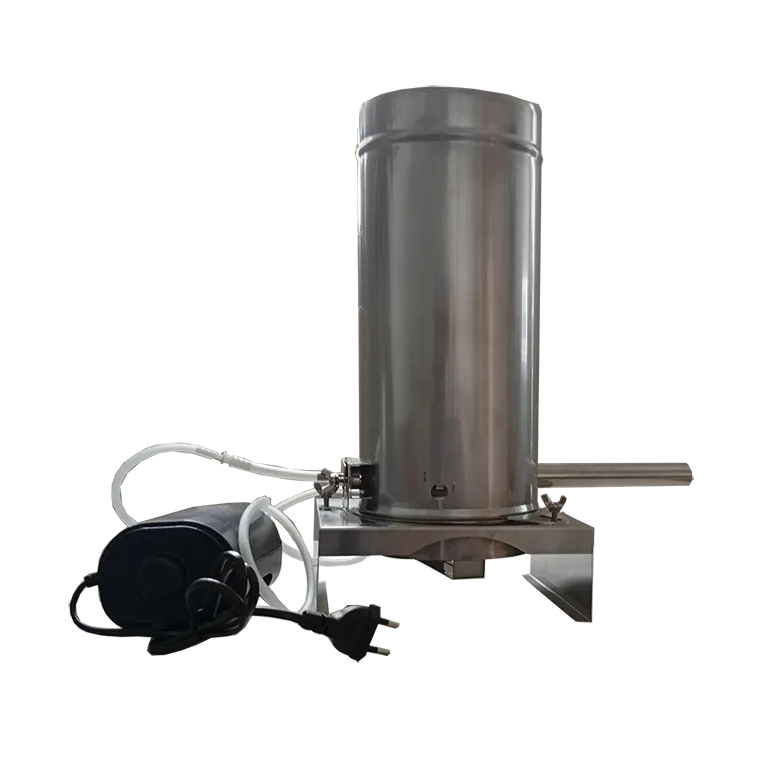
Want to build or adapt a cold-smoking cabinet without making a smoke generator yourself? A practical approach is to use a clean, suitable cabinet as the smoking chamber and produce smoke outside it with a purpose-built generator. This guide is about the cabinet itself: choosing its materials, planning the smoke inlet and outlet, hanging food, managing condensate and testing the airflow before the first smoking session.
Quick answer: use a stable, cleanable cabinet intended for food smoking; install a suitable low smoke inlet and a controlled outlet higher up; keep the generator and pump outside; make room for smoke to travel past—not directly blast onto—the food; install a thermometer at food height; then do an empty-chamber smoke and temperature test. There is no universal cabinet size or vent diameter that can safely be prescribed for every smoke generator and weather condition.
1. Understand the difference: smoke source versus smoking cabinet
A cold smoke generator creates smoke by smouldering wood chips with controlled air supply. A smoking cabinet contains the food and directs smoke around it. Separating these jobs makes it easier to access the chips and clean the smoke path, but it does not automatically control food temperature or eliminate food-safety risks.
With TISKRE-DO, SG1 and SG2 are external smoke generators, made in Estonia from stainless steel and aluminium. Both have 5.1 L, Ø130 mm chip containers and use dry 3–8 mm wood chips. SG1 has a passive three-plate cooler with a YE-923 air pump. SG2 adds an active five-layer labyrinth cooler-filter, a glass condensate collector and one dual-chamber YE-922 compressor. Each kit includes an adapter, a 0.6 m silicone hose and 1 L of alder chips.
2. Choose a suitable cabinet before choosing an inlet
You can start with a purpose-built metal smoking cabinet, or carefully adapt an existing enclosure that is demonstrably suitable for this use. Prioritise food-safe, corrosion-resistant contact surfaces that can be washed and inspected, stable shelves or hanging bars, a door that closes securely and access for cleaning. Keep the generator’s hot or smouldering parts outside the cabinet on a non-combustible, stable support.
- Good starting point: a dedicated smoking cabinet with accessible vents, washable interior and sufficient room around food.
- Investigate before using: a wooden enclosure or repurposed cabinet. Confirm material suitability, heat/fire behaviour, cleaning access and that no coatings or adhesives can contaminate food.
- Avoid improvising with: painted/pressure-treated wood, unknown plastics, old refrigerators with insulation and plastics of uncertain suitability, cabinets with flammable residues or equipment that cannot be cleaned properly.
- Do not guess cabinet capacity: matching a chamber to a generator requires an actual airflow and temperature test. A quoted volume alone cannot guarantee even smoke distribution.
3. Plan the smoke path: inlet, food zone and exhaust
Think of the system as a simple sequence: external generator → suitable adapter → cabinet smoke inlet → space around the food → controllable outlet. A lower inlet and an upper exhaust are often a useful starting arrangement, but the ideal location depends on cabinet geometry, racks and the manufacturer’s instructions. Do not make the cabinet completely airtight.
| Part of the system | What it must do | Common planning mistake |
|---|---|---|
| Inlet and adapter | Carry smoke into the chamber through a mechanically secure, suitable fitting | Forcing an adapter into an unsuitable hole; directing smoke straight at food |
| Food area | Leave space between items and cabinet walls for smoke circulation | Packing racks too tightly or blocking the inlet |
| Exhaust | Allow a controllable path for used smoke to leave | Sealing every opening to “keep the smoke in” |
| Temperature probe | Measure at representative food height, not just above the outlet | Assuming smoke temperature equals food temperature |
| Cleaning access | Let you inspect and remove deposits and condensate | Installing inaccessible bends and permanent sealed connections |
Choose inlet location only after deciding where food will hang. Do not let drips from food reach the generator, air pump or electrical connections. Do not install any internal heat source as part of this cold-smoking layout.
4. Install an external SG1 or SG2 safely
- Inspect the enclosure: it must be clean, stable, fit for food use and positioned outdoors away from combustible surroundings.
- Define the airflow route: identify a compatible inlet and a higher, controllable outlet before making or modifying any opening. If the cabinet is not built for smoking, seek competent installation advice.
- Position the generator outside: place it securely so the container can be filled and the cooler can be cleaned; protect pump and electrical parts from moisture in accordance with their instructions.
- Connect the supplied adapter and hose: check mechanical fit, sealing and hose routing. Avoid sharp edges, kinks and contact with hot surfaces; a 0.6 m supplied hose is not proof that every cabinet position will work.
- Prepare the fuel: use clean, untreated, dry 3–8 mm smoking chips. Fill the 5.1 L container loosely; do not compress fuel into a solid plug.
- Start following the manufacturer instructions: maintain a controlled smoulder rather than an open flame or maximum possible smoke.
- Test without food first: observe whether smoke reaches all food positions and exits in a controlled way. Check leakage, temperature, airflow and on SG2 the condensate jar.
- Operate only when conditions are appropriate: independently monitor the chamber and food process; stop if temperature, smoke flow or electrical safety cannot be controlled.
For lighting, pump adjustment, shutdown and cleaning, follow the separate SG1/SG2 operating guide. This article focuses on the design of the cabinet and connection.
5. Why a bigger cabinet is not automatically better
A large or tall smoking cabinet may provide space for more fish, cheese or meat, but effective smoke distribution depends on inlet and outlet locations, rack spacing, leakage, weather and the generator’s airflow. No published SG1/SG2 specification verified here establishes a maximum cabinet volume. Do not buy a generator solely on an unverified “litres of cabinet per pump” formula.
Instead, test the empty cabinet at several positions: Is smoke visible at upper and lower racks? Does it leave via the outlet rather than mainly leaking through the door? Can food be positioned without blocking the passage? Does the thermometer show conditions suitable for the specific food process? If the answer is no, solve the airflow or enclosure problem before increasing smoke output.
6. SG1 or SG2 for a cold-smoking cabinet?
| Feature | SG1 | SG2 |
|---|---|---|
| Smoke cooling | Passive, three-plate cooler | Active, five-layer labyrinth cooler-filter |
| Condensation management | No dedicated glass condensate vessel | Glass jar to collect condensate |
| Air pump | YE-923 | One dual-chamber YE-922 |
| Fuel | Dry 3–8 mm chips; 5.1 L | Dry 3–8 mm chips; 5.1 L |
| Practical reason to consider | Simple external smoke source with easy maintenance | Additional smoke cooling and easier monitoring of captured condensate |
The cabinet still needs appropriate ventilation and temperature checks in either case. To compare the products in detail, read SG1 vs SG2: which generator to choose?. To choose the wood fuel, see our guide to smoking wood chips.
7. First empty-cabinet test: record these five checks
Do not begin with fish or meat. Use an empty, clean cabinet to check the system. A useful test log records: (1) outdoor conditions; (2) chamber temperature measured in more than one rack position; (3) inlet and outlet settings; (4) whether smoke visibly moves through the entire cabinet; and (5) where condensate forms. Record the result rather than claiming a fixed burn time or universal temperature.
After switching off and allowing everything to cool completely, check for residue, ash, moisture and easy access to cleaning. If the test reveals leaks or blocked airflow, correct the mechanical problem before adding food.
8. Troubleshooting the cabinet, not just the generator
| Symptom | Likely cabinet-side issue | What to check |
|---|---|---|
| Smoke escapes mainly at the door | Poor sealing, obstructed outlet or an unsuitable inlet route | Inspect fittings and restore controlled exhaust; do not create a fully airtight chamber |
| Top rack receives smoke but lower rack does not | Short-circuit airflow path or racks blocking circulation | Adjust safe placement of food and verify inlet/outlet geometry by empty testing |
| Condensate drips on food | Cool surfaces and unsuitable tube or ceiling path | Inspect condensation points, cleaning access and position; keep deposits away from food |
| Cabinet temperature becomes unsuitable | Sunlight, ambient heat, stored heat or another heat source | Stop; measure at food height and wait for appropriate conditions |
| Smoke stops although the pump runs | Blocked inlet, kinked hose or fuel smoulder issue | Check the route, then consult the generator operating guide |
9. Food safety and fire safety are separate requirements
Cold smoke adds flavour; it does not cook raw fish or meat and does not reliably destroy Listeria or parasites. Safe processing may require controlled sourcing, validated salting or curing and parasite treatment where applicable, hygiene, monitoring, cooling and proper storage. Never infer food safety from the thickness of the smoke. Public food-safety resources explain the risks: CDC on Listeria in cold-smoked fish and Ontario guidance on smoking, external generators and circulation.
Use the generator only in an appropriate outdoor location; protect electrical equipment as directed, keep the smoking chamber and generator stable and accessible, and never leave an unsafe smouldering system unattended. This is a planning and inspection guide, not an engineer-certified cabinet build specification or a validated food-safety process.
Frequently asked questions
Can I make a cold-smoking cabinet from an old refrigerator?
Do not assume it is suitable. Insulation, liners, adhesives and residues in an old fridge may be inappropriate for a smoke process, and safe cleaning can be difficult. A purpose-built, cleanable food-smoking cabinet is the safer starting point.
Do I need to drill the cabinet for SG1/SG2?
Only use an inlet and adapter that can be installed safely and compatibly. A smoking cabinet with a suitable existing connection is preferable; drilling or fabrication on unsuitable materials requires a qualified assessment, not guesswork.
Should the exhaust be fully closed to get stronger smoke?
No. Smoke needs a controlled path out. A sealed chamber can lead to poor circulation and leakage.
Can I use the same generator for a Kamado grill?
Potentially, but grill and cabinet mounting needs differ. See the separate cold smoking in a Kamado guide for ceramic-specific considerations.
Does SG2 make the cabinet safe in hot weather?
No. The active cooler-filter can help manage the smoke before it enters the chamber, but cannot guarantee safe chamber temperatures in all conditions.
Next step: plan the inlet and outlet, test the empty cabinet, then choose the hardware that suits that setup. Compare the SG1 passive-cooler generator and the SG2 active cooler-filter generator; browse cold-smoking equipment and accessories.